Today’s long awaited blog post is dedicated to the online learning journal, Tapestry. I’ve been using it in my Reception class over the past year and a half and cannot recommend it highly enough.
This is my sixth year in Reception. I’ve taught in 3 different schools, and up until last year I was keeping evidence of children’s’ learning in the traditional scrap book format. This, as you all know, involved taking reams of photographs, downloading these onto a computer, printing them, guillotining them, sorting them, sticking them into books and, finally, annotating them. Parents would get to oooh and aaah over their child’s special books about once per term during parents meetings. Conscious that parents weren’t being involved enough I trialled sending their books home after these meetings, in order for parents to spend a little longer looking through the observations and to add in some observations from home. This only lasted a term because some books took weeks to be returned and, in one case, never came back!!!
I had had enough! When I applied for an EYFS leader position in May 2013 I accepted the post under the condition that I would be allowed to record evidence in an online journal. Thankfully my new head was willing to take a leap of faith and gave me the go ahead, purchasing iPad minis for me and my team. Hooray! My next task was to convince my new TAs! I trialled Tapestry over the summer and felt confident that anyone who was able to use a smart phone would be able to use the app. They both claimed to be ‘rubbish with technology’, but thankfully they were also keen to move away from all the photograph printing and sticking and so were willing to give it a try.
When I mentioned on social media that I was going to do a blog post about tapestry I was inundated with questions, which I hope to answer as best I can below. Please do bear in mind though that I am by no means an expert and have not received any form of training.
If I haven’t answered your questions you can check out Tapestry FAQ section the EYFS.info website –http://eyfs.info/tapestry-info/faqs#faq_17
What are the benefits of using an online learning journal?
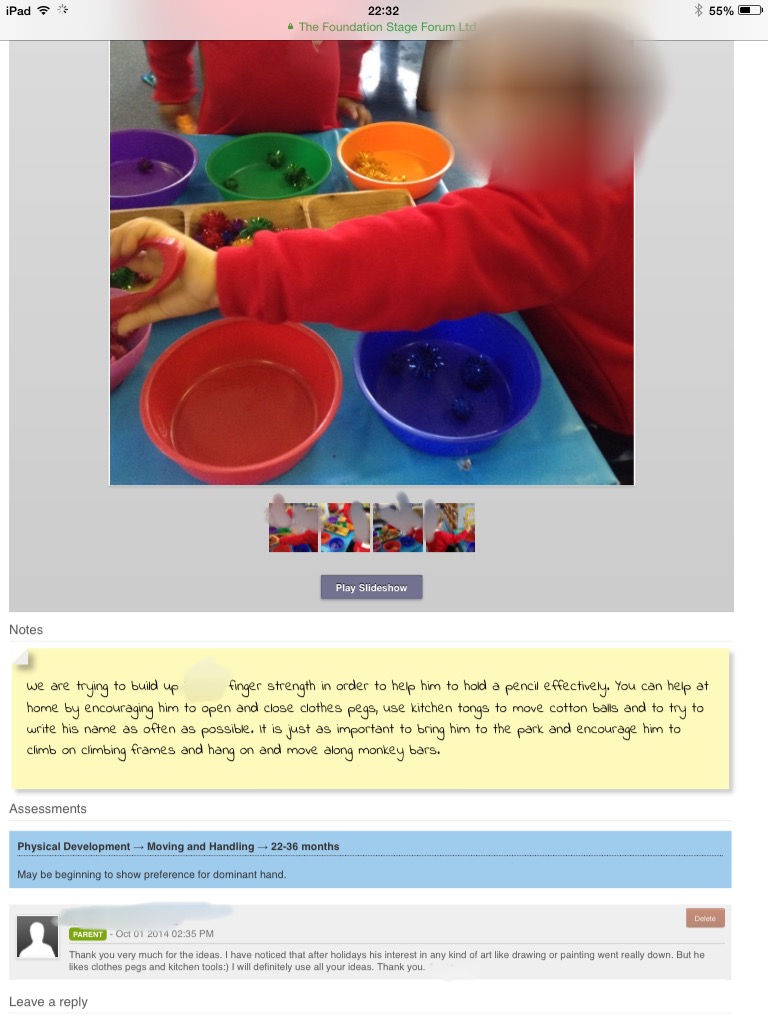
- First and foremost –it promotes a strong partnership with parents. Theyhave immediate access to their child’s learning. They can leave comments and also upload their own observations from home.

A teacher’s perspective on Tapestry Rockmyclassroom.com
Parent testimonials from last year:
“I find Tapestry wonderful and very easy to use. The mobile app is fantastic to upload pics and videos. It’s great to be able to get a peek at what your child does in school when you’re not around. I personally found it very easy to use and it’s easy to understand the targets your child is reaching.”
“Tapestry has been fantastic for us and it’s very simple to use and access. Every week I can’t wait for a new observation to inform me of what Peter is doing and the teacher’s comments. Loved every minute of his first year and Tapestry has been an integral part in showing his integration, what’s being taught and his progress. Genius idea!!!”
“I have found Tapestry really useful and have thoroughly enjoyed watching videos and seeing pictures of Jack at school. Its’ great to get an insight of what is going on in his school life as it is not always easy to find out this information from the children. Jack is also a big fan of looking at the pictures and videos posted on here of himself and it is something that we can do together and discuss what he has been doing in school. It is also very easy to use and to upload your own videos and pictures to enhance what has been taught in the classroom.”
- Parents gain a better understanding of the EYFS curriculum and appreciate the value of learning through play. You can link each observation with EY statements, characteristics of effective learning and the Leuven scales. You can choose whether or not to make these visible to parents. I tend to make statements visible so that parents are left in no doubt as to the wealth of learning that has gone on in one observation.
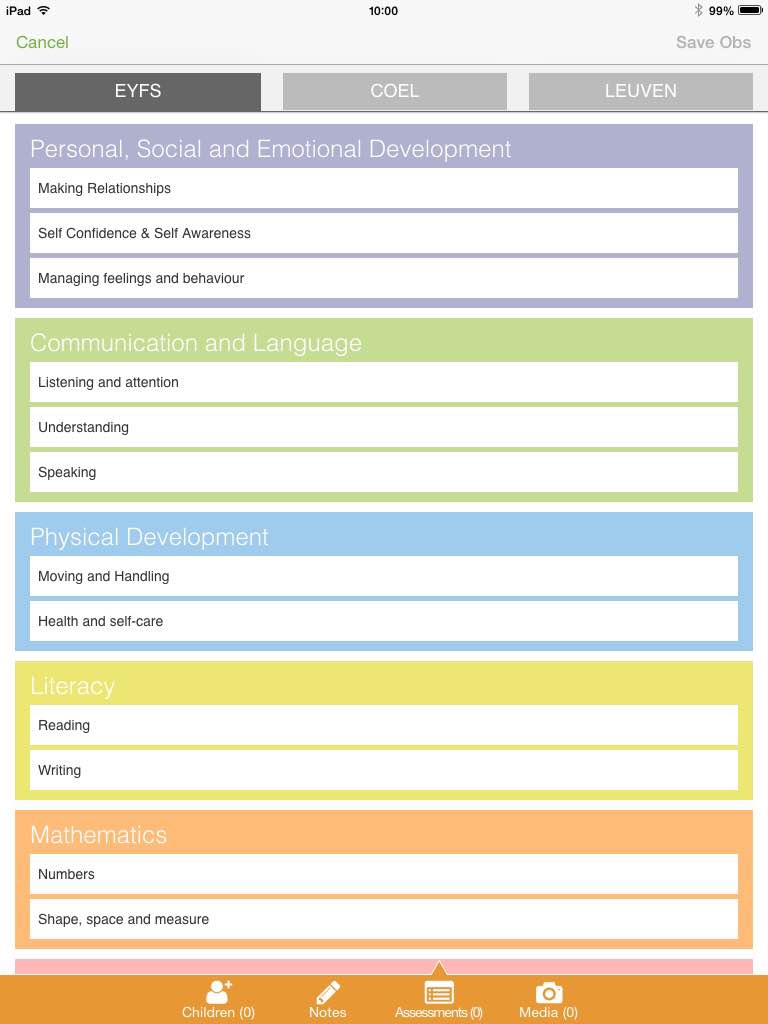
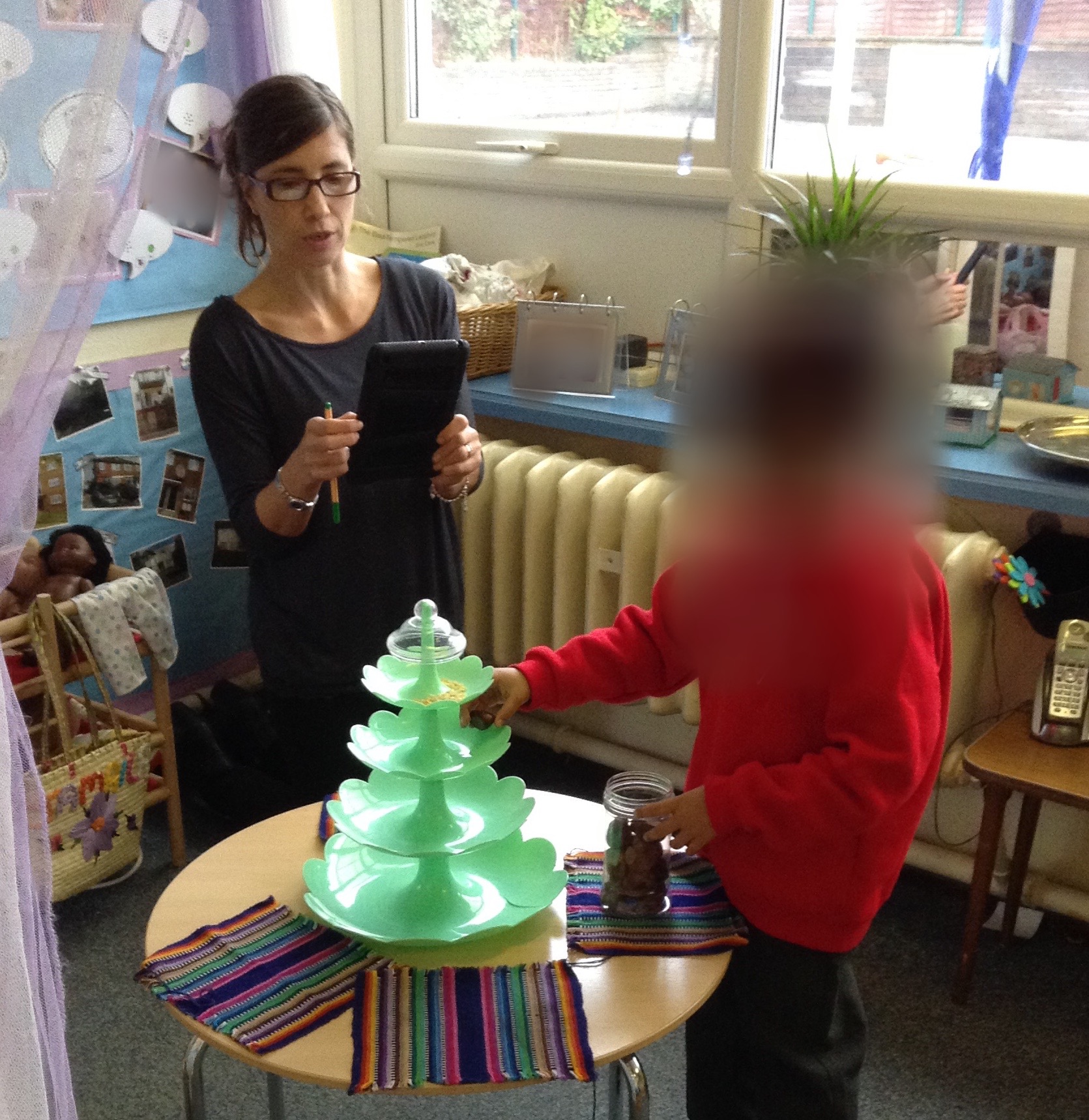
- The video function is fabulous and allows you to interact with and talk to the child throughout, without having to frantically write everything down.
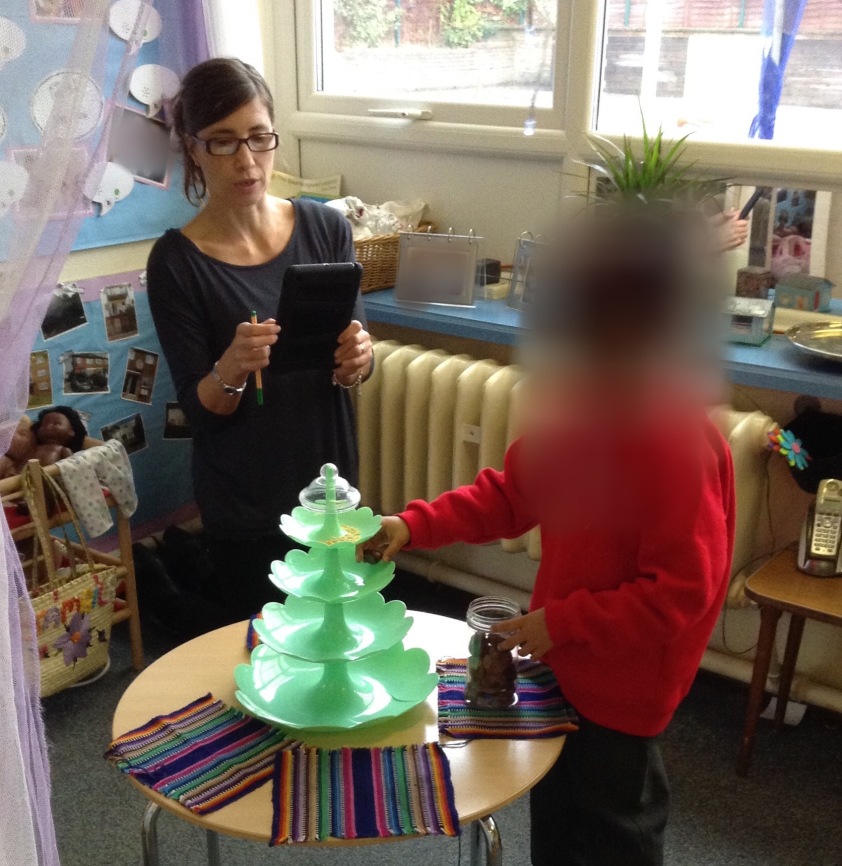
Tapestry in action rockmyclassroom.com
- You can use Tapestry to contact and inform parents e.g. every time we teach a new phoneme I ask my TA to record my introduction so that parents are clear on pronunciation and the corresponding Jolly Phonics action. We tag every child in the class so that it appears in each child’s profile.
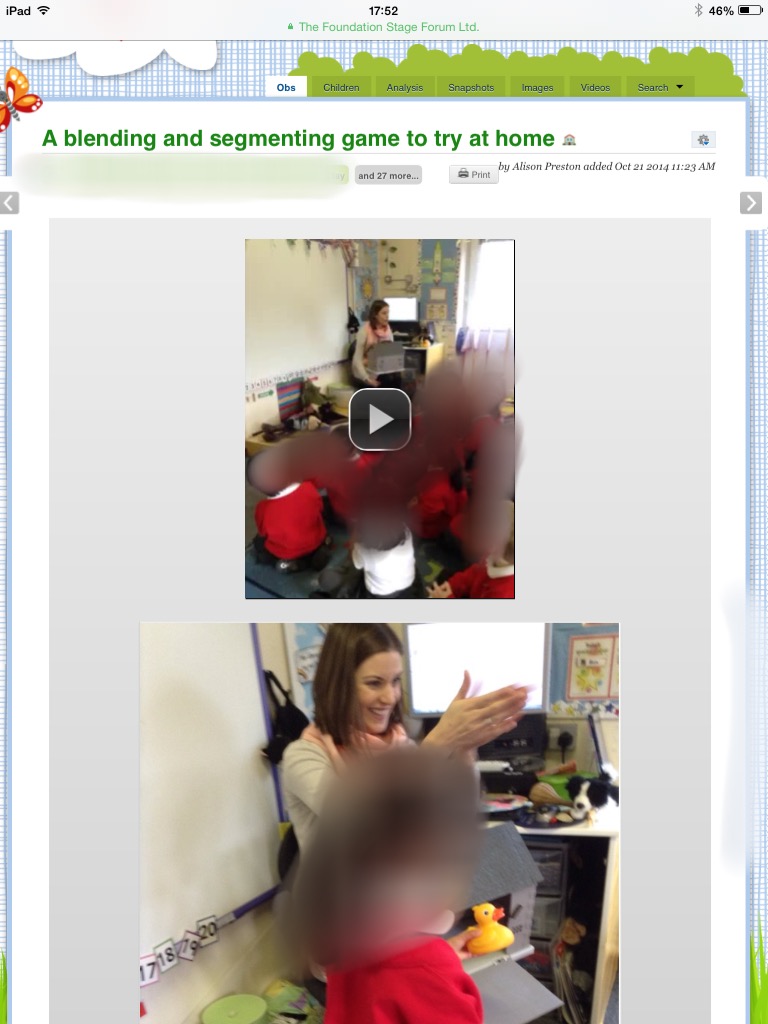
- It offers the practitioner the opportunity for some self-reflection. I have learned a lot about my questioning and involvement in children’s play. There are times I have watched a video back and kicked myself for asking too many questions!
- You can make whole class, group or individual observations. You can also go back and edit the observation before ‘publishing’ it and making it visible to parents.
- You can add as many family members to receive notifications as the parent wishes – Grandparents, older siblings who have left home to go to uni etc.
Why choose Tapestry?
- Parents are notified via email once an observation is ‘published’ (Some programmes don’t have this function, plus they also require that you annotate a photograph within a certain time frame before it is deleted from the system. Tapestry holds onto photos for as long as is required)
- It is very reasonably priced. For 60 pupils in Sept 2013, it cost me £36. Prices have gone up a little since, but not by much and with some programmes charging as much as £600, I think it is a bargain.
- It is incredibly user friendly and simple to upload observations via an app. As I mentioned above, if you are able to use a smart phone, you will be able to use the Tapestry app.
Do you use Tapestry to track children?
No. I use Tapestry in quite a basic sense in that it has replaced my camera, post it notes and long observation sheets. I do not use it to track children because in truth, I find the analysis section totally and utterly baffling. My main issues with are that:
- You cannot enter data by aspect. You have to enter scores one child at a time, which I find more time consuming.
- As far as I can tell there is no function for strand analysis.
- It doesn’t appear to generate percentage scores for you i.e. how many children are on track etc meaning you have to work it out yourself. I’ve been informed however that this is something the tapestry team are working on as we speak.
I currently use my Local authority spread sheet system to track my children, although our school is soon moving to O-track which appears to be very user friendly.
Does Tapestry record how many observations in each area there have been made for each child?
Yes it does, although pulling up this information isn’t the simplest as you have to navigate your way through the analysis section.
Do you still have paper scrap books in conjunction with an online journal?
Yes, I do. Because there weren’t any other settings using Tapestry in my local authority when I first started I was frightened to completely move away from paper journals. We currently keep children’s collage, paintings and writing samples in these special books, but record the processes on tapestry.
Can it be used into year 1?
Yes it can! Also, if a child is coming into your reception class from a different setting who are also using Tapestry, it’s possible to transfer all the observations over and continue with their nursery profile, and use their data. Similarly you can electronically transfer your Reception profiles up to the year one teacher should they wish to use it.
What happens at the end of the year?
You can create a PDF document on the learning journal to give to parents. I put these all on CDs at the end of the year. Unfortunately there is no way to save videos as far as I am aware.
Does each member of staff need an iPad?
I would say yes. Because of how we use Tapestry, in that it replaces all of our traditional methods of recording observations, from photos to post its, it’s important that everyone should have their tablet to hand, so that they don’t miss any learning opportunities.
How did the other staff take to Tapestry?
As I mentioned earlier both my TAs were initially apprehensive/terrified about using Tapestry. One thing that worried them for example was that they wouldn’t be able to record what the children were saying because they couldn’t type fast enough! They often wrote notes and then transferred these onto the tablet at a later date meaning that they were doubling up and having to work extra hard. As time went on they became much more confident and quicker at typing and so were able to ditch the notebooks! This year I have been encouraging them to use more video evidence and get over their self-consciousness at hearing themselves on video. They now agree that changing to the online journal system was the best thing we ever did.
If someone paid you to go back to the old paper system, would you?!
Absolutely not! In an era where more and more schools are using social media and blogs to interact with parents, it is only a matter of time before everyone changes to using online journals. Try not to be be scared, just embrace it!
If you have any more questions I would urge you to check out the foundation stage forum website here… http://eyfs.info/forums/forum/318-tapestry/
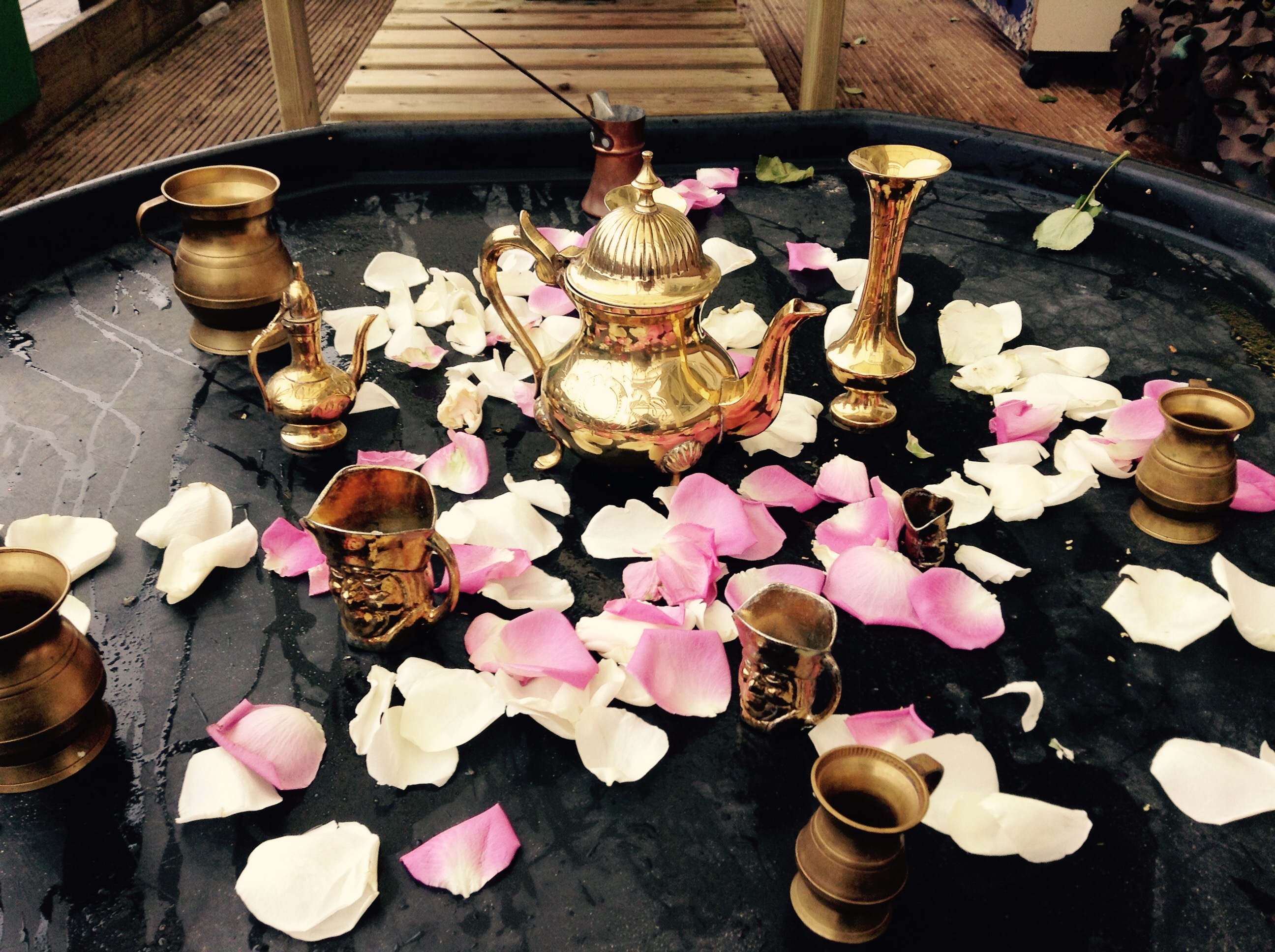

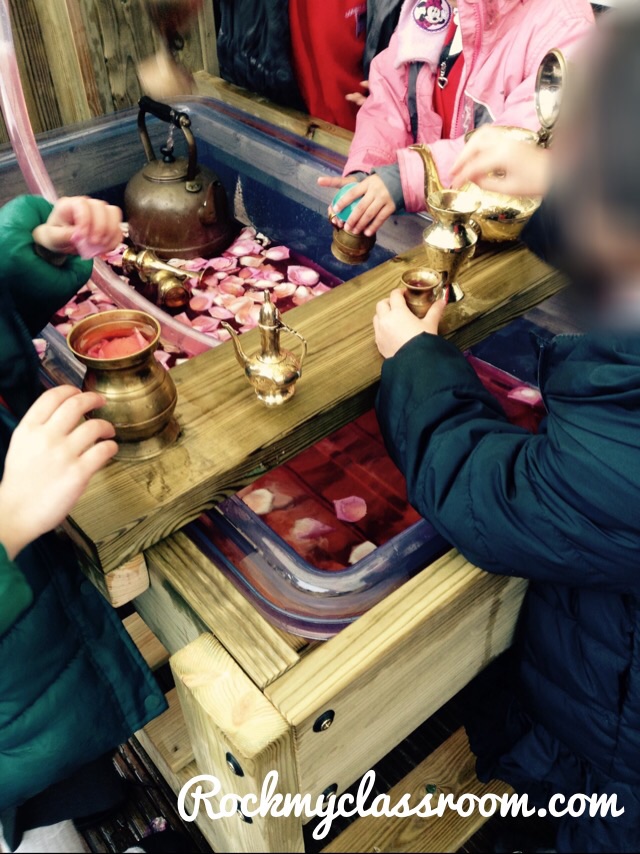


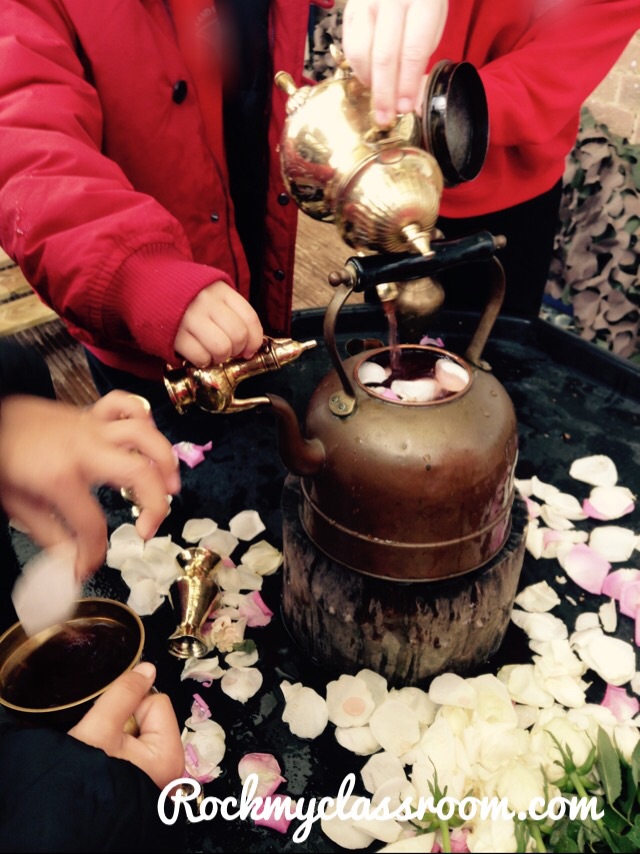 The vocabulary they used to describe the pots was rich and varied. I heard them using the words precious, heavy, shiny, golden, tiny and miniature. They soon introduced a potion making narrative into their play and even offered to make me a love potion! 😍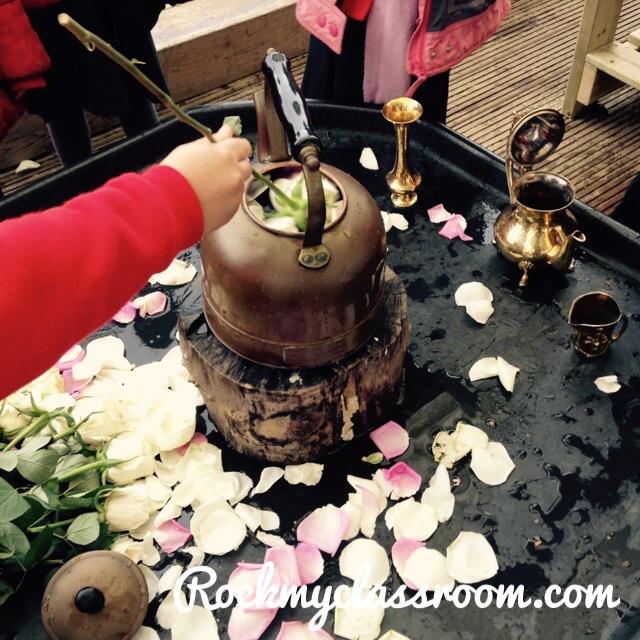


 Another outdoor water tray tip I have is that you need a lot of space. I have cleared the whole deck area and put a raised tuff spot nearby, along with large scale guttering and stands, so that the children have the space and freedom to play on a large scale.




 Rock My Classroom